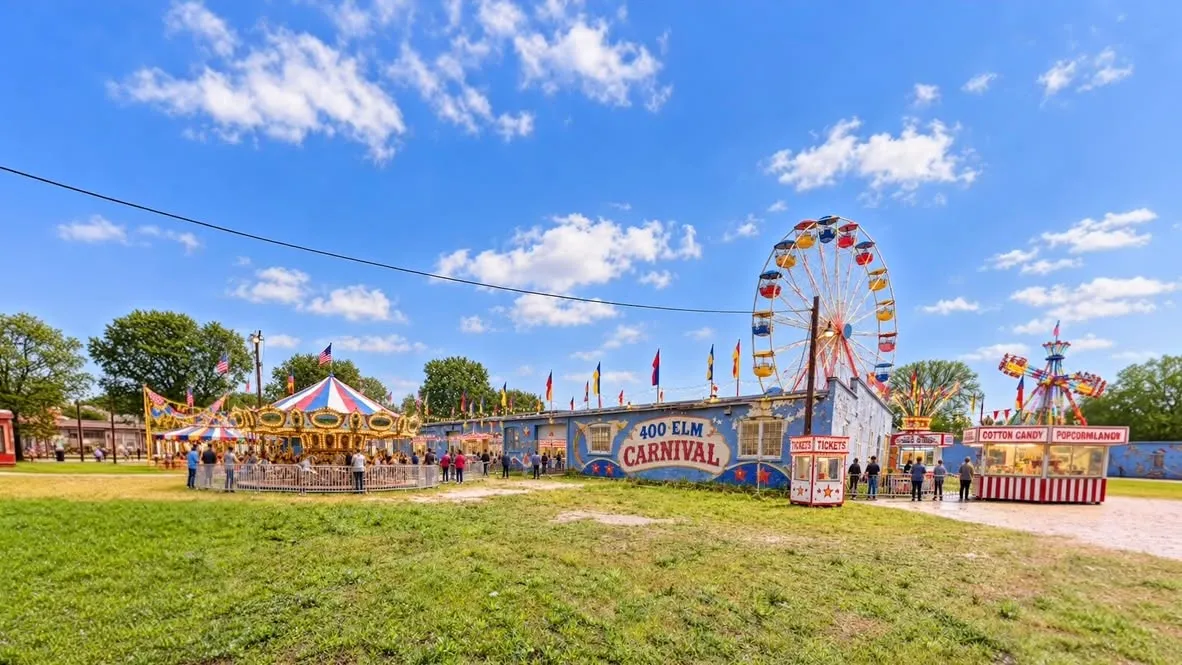
HOLLY — Shortly after taking ownership of the long-vacant industrial property at 400 Elm Street, the Village of Holly announced the 4.38-acre site will be redeveloped into a permanent carnival, ending decades of uncertainty over both the property and how many times a year a small town can reasonably install temporary fencing. The actual site transferred to Village ownership September 22 and contains roughly 63,000 square feet of deteriorated industrial buildings with no contributory value.
Plans call for a Ferris wheel overlooking Simonson Lake, two carousels, a permanent midway, year-round funnel cake production and enough electrical capacity to prevent future extension cords from crossing a public sidewalk at shin height. A portion of the former factory will be retained as an industrial heritage feature and incorporated into a spinning ride tentatively named The Brownfield, which will require riders to sign an environmental due-diligence waiver before boarding.
The decision follows an internal review of Holly’s event calendar, which found the Village was repeatedly constructing most of a carnival downtown and then dismantling it before residents had fully recovered. Under the new system, tents, vendor booths, decorative lighting, horse facilities and approximately 11 acres of things labeled “seasonal” will remain assembled indefinitely.
“We finally asked why we keep putting all of this away,” said a project representative. “Nobody had a good answer, so now the Ferris wheel is infrastructure.”
The carnival will be divided into several flexible-use districts capable of supporting Holly’s changing seasonal needs. The western midway will accommodate summer festivals and food vendors, while the eastern portion can be converted for witches, Victorian Christmas programming, wizards, historical reenactors or any future group arriving in town with unusual hats. A central plaza will remain unprogrammed so officials have somewhere to announce another event.
Village planners said the project could also relieve pressure on downtown Holly, where Broad Street and Battle Alley are routinely required to serve as streets, festival grounds, parade routes, pedestrian malls, historical backdrops and emergency kettle-corn corridors. Once the carnival opens, downtown could return to normal commercial use for as many as four weekends annually, although officials cautioned that two of those weekends may already conflict with Christmas.
The Village is also studying whether the Ferris wheel should operate year-round or be placed on a seasonal schedule. Preservation advocates have urged officials to decide quickly, noting that once the wheel has been standing for 18 months, removing or altering it may become impossible.
Future phases could add a roller coaster, additional vendor space and a municipal costume-storage building large enough to hold Holly’s growing strategic reserve of witches, Dickensians and decorative hay bales. If attendance continues to increase, officials said the Village may eventually acquire another industrial property to house the carnival overflow.
At that point, 400 Elm will be preserved as Holly’s historic original carnival.